A Leafy Green Powerhouse for Everyday Health
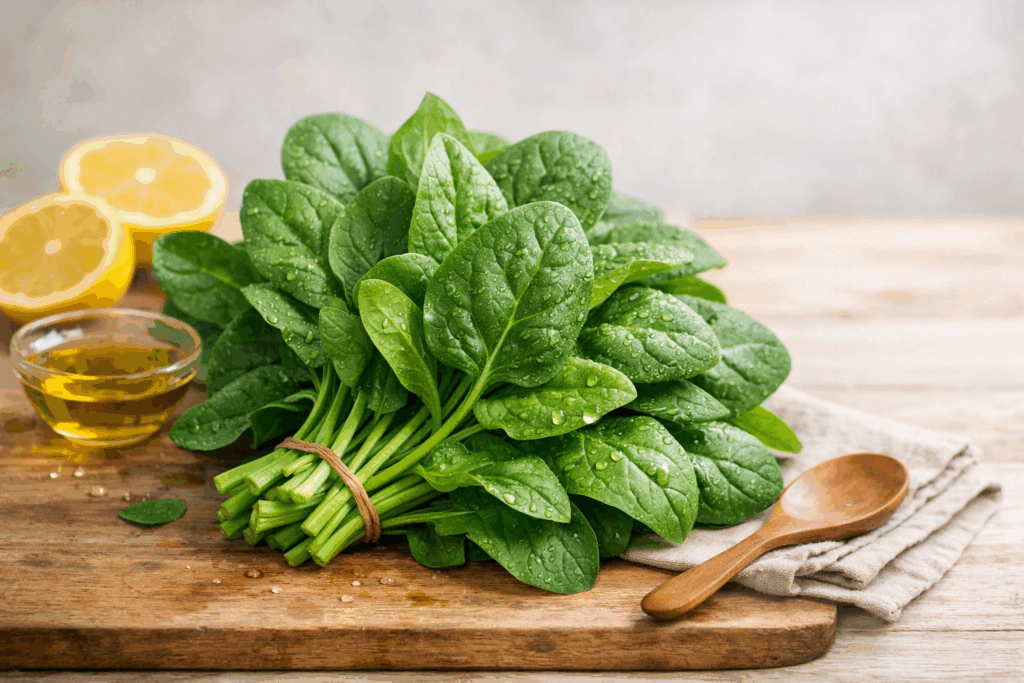
Spinach is one of the most nutrient-dense leafy greens you can add to your meals. Mild in flavor yet rich in vitamins, minerals, and protective plant compounds, spinach supports everything from heart and eye health to digestion and bone strength. Whether eaten raw, lightly cooked, or blended, this versatile vegetable earns its place as a nutrition staple.
1. Packed With Essential Nutrients
Spinach delivers a wide range of vitamins and minerals with very few calories.
Key nutrients in spinach include:
- Vitamin K – supports blood clotting and bone health
- Vitamin A (beta-carotene) – important for vision and immune defense
- Vitamin C – supports immunity and collagen production
- Folate (B9) – critical for cell growth and pregnancy health
- Iron – helps transport oxygen in the blood
- Magnesium & potassium – support muscle, nerve, and heart function
A single cup of raw spinach provides significant amounts of these nutrients with minimal fat or sugar.
2. Supports Heart Health
Spinach is rich in dietary nitrates, compounds shown to help relax blood vessels and improve blood flow. This may help:
- Lower blood pressure
- Improve circulation
- Reduce risk of cardiovascular disease Its potassium and magnesium content further supports healthy heart rhythm and vascular function.
3. Promotes Eye Health
Spinach contains the carotenoids lutein and zeaxanthin, antioxidants that accumulate in the retina.
These compounds help:
- Filter harmful blue light
- Reduce the risk of age-related macular degeneration
- Support long-term visual clarity
4. Helps Fight Oxidative Stress & Inflammation
Spinach is rich in polyphenols and flavonoids that act as antioxidants. These compounds help neutralize free radicals, which may:
- Reduce chronic inflammation
- Support healthy aging
- Lower risk of certain chronic diseases
5. Aids Digestion & Gut Health
Spinach provides dietary fiber that:
- Supports regular bowel movements
- Feeds beneficial gut bacteria
- Helps maintain healthy blood sugar levels
Cooked spinach is especially gentle on digestion while still retaining key nutrients.
6. Supports Bone Strength
Thanks to its high vitamin K content, spinach plays a role in:
- Bone mineralization
- Calcium regulation
- Reduced fracture risk
Pair spinach with calcium-rich foods for even greater bone-support benefits.
7. Easy to Add to Any Meal
Spinach’s mild flavor makes it incredibly versatile:
- Toss into salads or wraps
- Sauté with garlic and olive oil
- Blend into smoothies
- Add to soups, stews, omelets, and pasta
- Use in pastries
Cooking spinach slightly increases the absorption of some nutrients, such as iron and calcium, however, a team of researchers from Linkoping University in Sweden found that the maximum amount of lutein , the powerful antioxidant is obtained, from raw spinach consumed as smoothies or juice. More lutein is released from spinach when it is chopped finely.
To get the most out of spinach alternate preparation methods between raw and cooked
Spinach is a low-calorie, high-impact vegetable that supports heart health, vision, digestion, bones, and overall wellness. Including it regularly, raw or cooked is a simple, science-backed way to improve diet quality and nutrient intake.
Ionie Ponde, MS, RD, LDN
B Food Savvy 
References:
- US Department of Agriculture
- National Institute of Health Office of Dietary Supplements https://ods.od.nih.gov/factsheets/list-all/
- Olas B. February 24th, 2024, The Cardio Protective Role of Nitrate Rich Vegetables, Foods, PMCID: PMC10931520 PMID: 38472804
- Julie Mares, July 17th, 2016, Lutein and Zeaxanthin Isomers in Eye Health and Disease, Annu Rev Nutr, PMCID: PMC5611842 NIHMSID: NIHMS867278 PMID: 27431371
- PanelMostafa Norouzzadeh, Minoo Hasan,Rashedi, Nastaran Payandeh, Artemiss Mirdar Harijani, Hossein Shahinfar, March, 2024, The effects of dietary nitrate on blood pressure and vascular Health: An umbrella review and updated Meta-Analysis and meta-regression, Journal of Functional Foods, https://doi.org/10.1016/j.jff.2024.106082
- Joseph L. Roberts and Régis Moreau , Jue 22nd, 2016, Functional properties of spinach (Spinacia oleracea L.) phytochemicals and bioactives, Food & Function, PMID: 27353735 DOI: 10.1039/c6fo00051g
- Arun Kumar Balasubramaniam, Ganesh Saste, Azazahemad A. Kureshi, Vallabh Mulay, Lal Hingorani, September 2025, Nutritional and health beneficial properties of spinach (Spinacia oleracea L), Science Direct, https://doi.org/10.1016/j.prenap.2025.100368Get rights and content
- Emma F. Jacquier, Amira Kassis, Diana Marcu, Nikhat Contractor. Jina Hong, Chun HuMarissa Kuehn, Christopher Lenderink, Arun Rajgopal, July 11th, 2024, Phytonutrients in the promotion of healthspan, Nutr., https://doi.org/10.3389/fnut.2024.1409339
- Boris Nemzer, Fadwa Al-Taher, Nebiyu Abshiru, April 26th, 2021, Extraction and Natural Bioactive Molecules Characterization in Spinach, Kale and Purslane: A Comparative Study, Molecules, PMCID: PMC8123472 PMID: 33925848
- Katarzyna Maresz, February 14th, 2015, Proper Calcium Use: Vitamin K2 as a Promoter of Bone and Cardiovascular Health, Integr Med (Encinitas), PMCID: PMC4566462 PMID: 26770129
- Peter Cronin, Susan A. Joyce, Paul W. O’Toole and Eibhlís M. O’Connor, May 13th, 2021, Dietary Fibre Modulates the Gut Microbiota, NUTRIENTS, doi: 10.3390/nu13051655
- James M Lattimer and Mark D Haub, December 15th, 2010, Effects of Dietary Fiber and Its Components on Metabolic Health, Nutrients, PMCID: PMC3257631 PMID: 22254008
- Thomas M Barber, Stefan Kabisch, Andreas F H Pfeiffer, Martin O Weickert, October 21, 2020, The Health Benefits of Dietary Fibre, Nutrients, PMCID: PMC7589116 PMID: 33096647
- Laura Brown, Senior Lecturer in Nutrition, Food, and Health Sciences, Teesside University, June 10th, 2022, 9 Vegetables That are Healthier for You When Cooked, The conversation, https://theconversation.com/nine-vegetables-that-are-healthier-for-you-when-cooked-182723
- Rosanna W.S. Chung, Per Leanderson , Nelly Gustafsson, Lena Jonasson , March 30th, 2019, Liberation of lutein from spinach: Effects of heating time, microwave-reheating and liquefaction, Food Chemistry, https://doi.org/10.1016/j.foodchem.2018.11.023Get rights and content
- Lena Jonasson, Rosanna W.S. Chung , December 2018, Getting the Most out of spinach: Maximizing the antioxidant Lutein, Linköpin University, https://liu.se/en/news-item/mixad-spenat-for-maxad-mangd-antioxidant#:~:text=More%20lutein%20is%20released%20from,and%20the%20Swedish%20Research%20Council